
Introduction
Taiwan is now Malaysia's fourth-largest trading partner and seventh-largest source of foreign direct investment, supporting more than 470,000 jobs locally. Bilateral trade is projected to grow between 20 and 30 per cent this year, driven principally by the electrical and electronics sector.
For Malaysian practitioners and their clients, developments in and around Taiwan are no longer a matter of distant geopolitics. They now feed directly into industrial land transactions, foreign residential acquisitions, treaty protection for inbound capital, and contractual risk allocation in supply agreements. This bulletin sets out four channels of transmission and the legal considerations each raises.
1. Supply Chain Relocation: The "Taiwan Plus One" Effect
Taiwanese manufacturers are pursuing diversification strategies that place production capacity outside the island. Malaysia is a principal beneficiary, with enquiry flow concentrated in Penang and Johor.
Recent activity includes Delta Electronics opening a Johor Bahru office in the Southern Industrial and Logistics Clusters zone in July 2026; ASE Technology Holding and TecoBar Technology in Penang; Wiwynn in Johor in data centre equipment; and Elite Material Co's RM900 million copper-clad laminate facility at Penang Science Park North.
Legal considerations
Land acquisition consent. Any acquisition of land by a foreign company or non-citizen requires the prior approval of the State Authority under section 433B of the National Land Code 1965. Approval is discretionary, conditions are commonly imposed, and processing timelines vary materially between states. Transaction documents should provide for a conditions precedent period calibrated to the relevant state's practice, with clear allocation of the risk of refusal or conditional approval.
Structure selection. Where the incoming investor establishes a Malaysian-incorporated subsidiary with foreign shareholding, the entity remains a "foreign company" for the purposes of section 433B and the Guideline on the Acquisition of Properties issued by the Economic Planning Unit. Practitioners should not assume that local incorporation removes the consent requirement.
Leasehold industrial land. Much of the relevant stock in Bayan Lepas, Batu Kawan, Kulim Hi-Tech Park, and Senai Airport City is held on state leasehold with restrictions in interest and industry-specific express conditions. Due diligence must confirm that the intended use falls within the category of land use and express conditions, and that any variation application under section 124 of the National Land Code is factored into the timeline.
Incentive conditions. Investment incentives granted by MIDA or state investment corporations frequently carry employment, local-sourcing, and operational commitments. These should be reviewed against the sale and purchase agreement and any development agreement, as breach may trigger clawback independently of the land transaction.
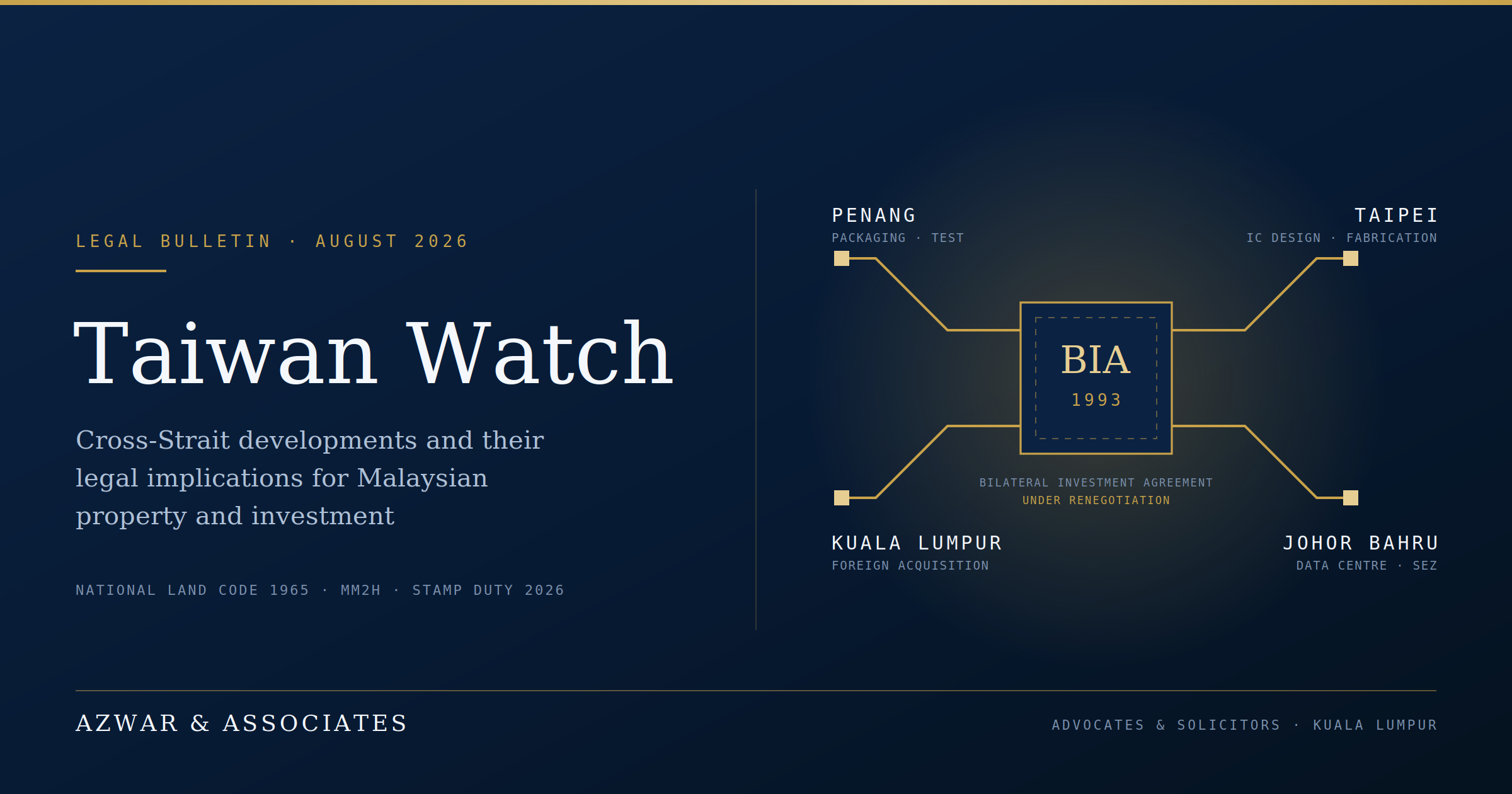
2. The 1993 Bilateral Investment Agreement: Renegotiation Underway
Taiwan has formally urged Malaysia to open negotiations to update the Malaysia–Taiwan Bilateral Investment Agreement signed in 1993. The Taipei Economic and Cultural Office has observed that the instrument contains only ten provisions and does not address intellectual property protection, technology transfer, or capital injected from a third jurisdiction.
Discussions have commenced at director-general level between Taiwan's Ministry of Economic Affairs and Malaysia's Ministry of Investment, Trade and Industry under the Malaysia–Taiwan Economic Cooperation framework. Taiwan is pressing for engagement at a higher level to capture labour and working visa matters, which fall across several ministries. The proposal has attracted domestic support, with the Penang Assembly Speaker publicly endorsing an update to strengthen semiconductor cooperation.
Why this matters to advisers
The existing instrument offers limited substantive protection and, on its face, no meaningful investor–state dispute resolution architecture comparable to modern treaty practice. Clients structuring significant Taiwanese inbound investment should be advised that:
Treaty-based protection is presently thin, and commercial protection must therefore be built into the transaction documents themselves — governing law, seat of arbitration, stabilisation undertakings where available, and political risk insurance.
Routing investment through a third jurisdiction with a more robust Malaysian investment treaty may be worth modelling, subject to substance and anti-treaty-shopping considerations.
Where an updated agreement is concluded, transitional provisions will determine whether existing investments benefit. Investments made now should be documented with sufficient clarity to establish the date, form, and quantum of the investment.
3. Tariff Exposure: The Principal Downside Risk
The most material economic risk to Malaysia arising from the Taiwan file is not military. It is competitive.
In January 2026 the United States and Taiwan concluded a trade arrangement under which Taiwanese semiconductor and technology companies commit to manufacturing investment on US soil in exchange for reduced tariffs on Taiwanese exports. The effect on relative competitiveness is already visible in the trade data: Malaysia supplied US$21.5 billion in chips to the United States in 2021 as the largest single source, falling to US$11.2 billion by 2025, by which point Taiwan had displaced Malaysia at the top of the import list.
Malaysian semiconductor exports currently benefit from exemptions pending the outcome of a United States national security investigation. The Government has warned that removal of those exemptions could reduce competitiveness and strain sectors closely integrated with United States supply chains. Budget 2026 documents project GDP growth lower by 0.76 percentage points as a consequence of United States tariff measures, with both imports and exports expected to contract.
Contractual implications
Clients with United States-facing supply agreements should review:
Tariff and duty allocation clauses. Silence on who bears newly imposed duties is a common defect. Incoterms alone do not resolve the question where a duty is imposed mid-contract.
Price adjustment and hardship provisions. A tariff imposition is unlikely to constitute frustration at Malaysian law. Relief must be contractual.
Force majeure drafting. Standard formulations rarely capture the imposition of trade measures. Where the parties intend such an event to excuse or suspend performance, it must be expressly enumerated.
Rules of origin and substantial transformation. For packaging and testing operations, origin determination is outcome-determinative on tariff exposure. Contractual warranties as to origin should be given with care and supported by documentation.
4. Cross-Strait Security: Escalating, but Below Crisis Threshold
Military pressure around Taiwan has intensified without crossing into open conflict. China conducted two days of live-fire exercises near Dongshan Island on 23 and 24 July 2026, limited in scale but contributing to the normalisation of coercive activity. Taiwan commenced its annual Han Kuang exercises in early August 2026, deploying naval missile launchers, armour, and requisitioned civilian vehicles. In December 2025, China conducted its most extensive encircling exercises to date following a United States arms package valued at US$11.1 billion.
The effect on Malaysia is two-directional. Sustained low-level tension accelerates supply chain relocation into Malaysia, which supports industrial property values and foreign direct investment. A blockade or conflict scenario would be severely adverse, given ringgit sensitivity, Strait of Malacca exposure, and dependence on electrical and electronics exports.
Advisers should treat this as a risk to be documented rather than predicted. Long-tenor leases, build-to-suit arrangements, and joint venture agreements involving Taiwanese counterparties should address suspension, termination, and step-in rights in the event of prolonged disruption to the counterparty's home jurisdiction.
5. Foreign Residential Acquisition: Taiwanese Buyers and the 2026 Stamp Duty Increase
Taiwan is the second-largest source market under the revamped Malaysia My Second Home programme. Of 14,535 applications lodged since the 2024 restructuring, 2,419 originated from Taiwan, behind only mainland China. Taiwanese participants completed 91 of the 744 MM2H-linked property purchases recorded to 31 December 2025.
Two developments bear on this segment:
Stamp duty. With effect from 1 January 2026, non-citizen buyers who are not permanent residents pay a flat 8 per cent ad valorem duty on the instrument of transfer for residential property, doubled from the previous 4 per cent. This is the single largest increase in acquisition cost for foreign buyers in over a decade and materially affects transaction viability at the lower thresholds.
State thresholds remain determinative. Federal MM2H tier minimums do not displace state-level minimum purchase prices. Kuala Lumpur applies RM1 million irrespective of tier; Penang Island applies RM3 million for landed property; certain states permit strata acquisitions from lower thresholds. Malay Reserved Land, low-cost and medium-cost housing, and Bumiputera quota units remain unavailable regardless of price or visa status.
Practice point. MM2H participants are subject to a compulsory property purchase within twelve months of visa endorsement and a ten-year disposal restriction. Where a client contemplates early exit, the interaction between the programme condition, any private caveat, and real property gains tax should be addressed in advance rather than at the point of sale.
What to Monitor
DevelopmentPractical significanceProgress of the Bilateral Investment Agreement renegotiationTreaty protection and dispute resolution for Taiwanese inbound investmentUnited States determination on semiconductor tariff exemptionsDirect exposure for Malaysian electrical and electronics exporters and industrial demand in Penang and KedahConversion rate of Taiwanese MM2H applications post-8 per cent dutyForeign residential demand in Kuala Lumpur, Penang, and JohorEscalation beyond exercise activity in the Taiwan StraitRinggit, shipping, and broader investment sentiment
Conclusion
The Taiwan file presents Malaysia with concurrent opportunity and exposure. Supply chain diversification is delivering real industrial investment into Penang and Johor, and the pending renegotiation of the 1993 investment agreement may improve the protection available to that capital. At the same time, tariff differentials arising from the United States–Taiwan arrangement operate against Malaysian competitiveness, and the increased stamp duty burden on foreign residential buyers has raised the cost of entry for a source market in which Taiwan ranks second.
For advisers, the practical response is unremarkable but essential: build protection into the documents, do not rely on treaty coverage that may not exist, and address tariff and disruption risk expressly rather than by implication.
Azwar & Associates advises on conveyancing, security documentation, and corporate and commercial matters. For further information on any matter discussed in this bulletin, please contact our offices at Megan Avenue 1, Kuala Lumpur.
This bulletin is provided for general information only and does not constitute legal advice. It reflects the position as at August 2026. Readers should obtain specific advice before acting on any matter discussed.
